AI scoring for tenders: from 80-120 postings a day to 3-5
Monitoring procurement and project boards across two sources: postings parsed, the brief scored 0-10 by an LLM, HOT and WARM sent to Telegram. Monitoring used to take 2-3 hours a day.
- Scale
- 2 sources, automatic run every 6 hours
- Stage
- Running in production
- Delivered
- 2026
Cortex IT builds systems like this end to end: one process, from analysis to production in 1-2 months. Pilot from $3,000. First step: a free 30-minute call, no pitch.
TL;DR. Out of 80-120 postings a day, 3-5 were worth pursuing — and finding them took 2-3 hours every day. The system parses postings from two sources, a small language model scores the brief on a 10-point scale, and only relevant lots reach Telegram. Runs automatically, every 6 hours.
For how this works under the hood, see the AI call analytics guide.
Situation: monitoring procurement eats the working day
Tender platforms and project boards publish dozens of lots a day. Out of 80-120 postings, 3-5 turn out to be a fit — but finding them means opening each one: reading the brief, working out what it is really about, matching it against your profile of work.
Keyword filtering on the platform side doesn't solve it: "automation" surfaces conveyor supply contracts, while a genuine computer vision project may be titled "upgrade of the CCTV system". The sorting falls on a human — 2-3 hours a day, every day.
Task
- Take the reading of postings off a human entirely.
- Score the brief on meaning, not on keyword matches.
- Send only what is worth opening, to the channel that is already open.
- Hold processing cost at a level where running it daily is not a discussion.
What we built
The system pulls postings from two sources: state procurement and a project board. Each source has its own adapter — API, RSS, or parsing procurement documents in PDF and DOCX.
The extracted brief goes to a language model, which scores the lot on a 10-point scale against the profile of work and assigns a status: HOT, WARM or COLD. HOT and WARM go to Telegram with a link and a short justification of the score. COLD stays in the log and the spreadsheet — checkable, but not distracting.
The run is scheduled every 6 hours through the system scheduler. Processed postings are marked in a local database, so the same lot never arrives twice.
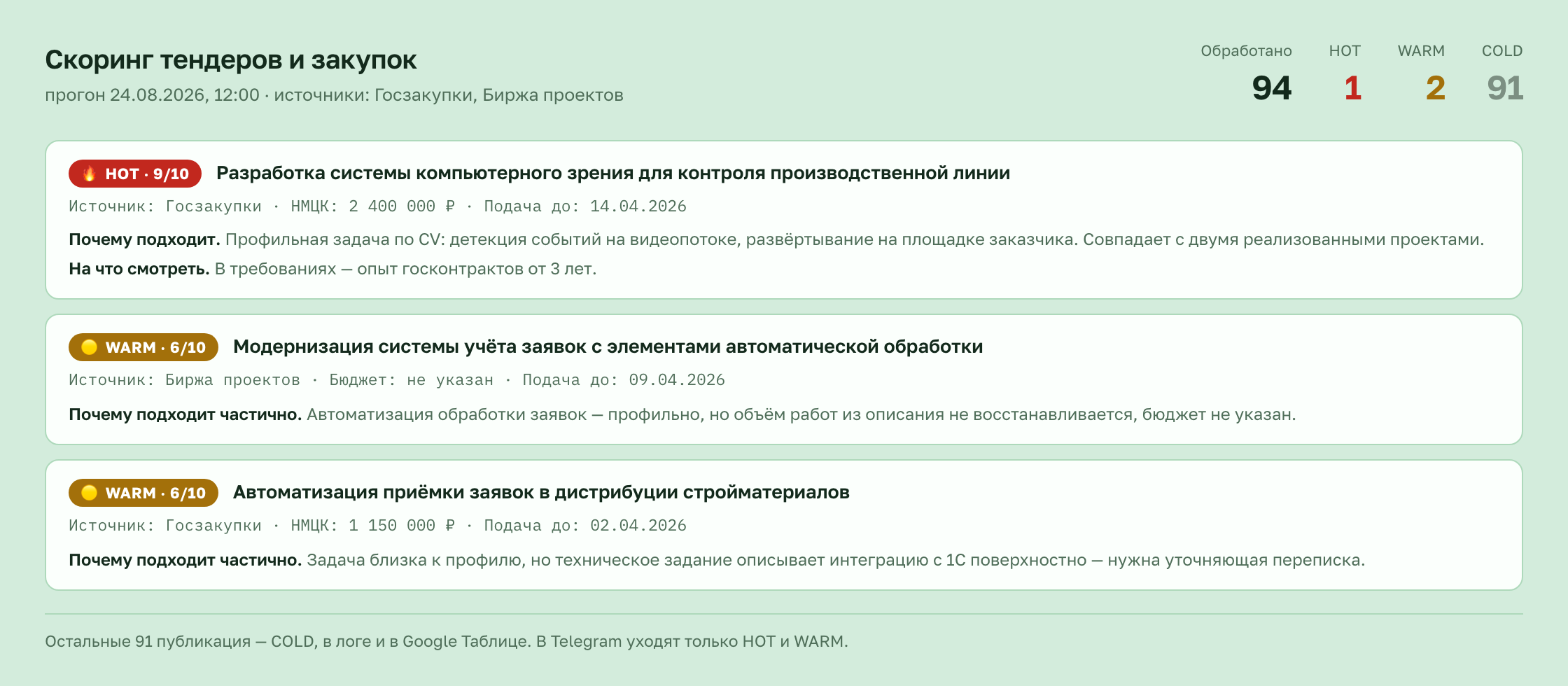
Result
- Time spent monitoring went from 2-3 hours a day to zero.
- Telegram receives 3-5 relevant lots instead of 80-120 postings to review by hand.
- No missed relevant tenders have been recorded since it went live.
- Processing cost stays low enough that running every 6 hours needs no budget conversation.
Key technical decisions
- Caching the system prompt between calls. The profile of work and the scoring criteria are identical for every lot in a run. Caching that part of the request removes the main cost line in bulk scoring.
- A small model for the bulk stage. First-pass filtering doesn't need a frontier model: the task is telling relevant from irrelevant, not writing an analysis. Matching model to task matters more here than the quality of the prose.
- Deduplication in a local database. A posting is marked processed by its identifier. Without that, a 6-hour cadence would deliver the same lot four times a day.
- Two sources, two adapters, one scorer. The platforms' data formats differ; the scoring criteria don't. Separating the collection layer from the scoring layer means a new platform can be added without touching the scoring logic.
FAQ
Why an LLM rather than a keyword filter?
Keywords produce both false positives and misses: a computer vision project may be titled "upgrade of the CCTV system" and contain none of the expected terms. The model scores the brief on meaning.
What does a daily run cost?
Cost is held down by caching the system prompt and using a small model for the bulk stage. That is a deliberate design decision: if scoring is expensive, the daily run is the first thing to get dropped.
Can another platform be added?
Yes. Collection and scoring are separate: a new platform means a new collection adapter, and the scoring criteria stay as they are.
What would come next
The natural continuation is a feedback loop on outcomes: marking which lots turned into contracts and tuning the scoring criteria against actual wins. After that, predicting win probability from the buyer's parameters and procurement history.
If sorting leads or tenders costs you hours a day, let's talk it through in 30 minutes.
Stack
- Python
- LLM API with prompt caching
- SQLite
- Telegram Bot API
- launchd
- Google Sheets